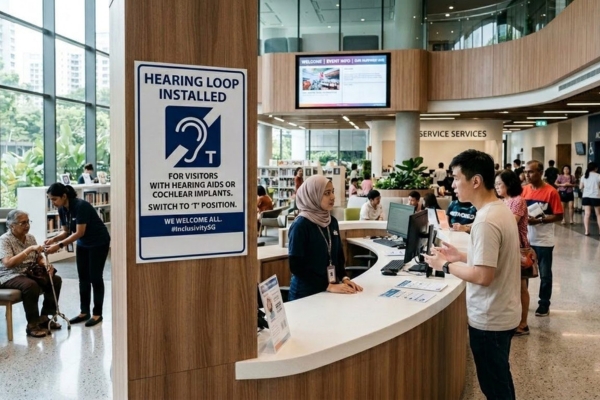
The Hidden Legal and Reputation Risks of Poor Hearing Accessibility


In Singapore, poor hearing accessibility is no longer a “nice to have” problem—it is becoming a compliance, operational and reputation risk for building owners, operators, and brands. The combination of evolving accessibility requirements and clearer expectations around inclusion means that ignoring hearing access can quietly hurt approvals, trigger complaints, and damage trust with customers and staff.

Why hearing accessibility is now a compliance issue

Singapore’s Building and Construction Authority (BCA) Code on Accessibility has, since 2013, required new buildings and those undergoing additions and alterations to provide Hearing Enhancement Systems (HES) in specified spaces, such as rooms used for conferences, lectures, and presentations. These requirements were maintained and strengthened in subsequent revisions (2019 and 2025), reflecting Singapore’s vision of accessibility that explicitly includes people with hearing impairment, not only those with mobility challenges.

For developers, landlords, and facility managers, this means that hearing systems (loops, FM, IR or equivalent) and proper signage are now part of baseline regulatory expectations rather than optional extras. Non-compliance can surface during design review, TOP/CSC, or later retrofits, leading to redesign, delays, and unplanned retrofit costs that are far higher than getting it right the first time.

The hidden legal risk: rights and complaints

Singapore has ratified the UN Convention on the Rights of Persons with Disabilities (CRPD), which recognises access to information and communication as a core right for persons with disabilities, including deaf and hard-of-hearing people. While Singapore does not yet have a single omnibus disability-rights act, legal and policy expectations are moving in the same direction: public-facing services should provide reasonable accommodations and avoid exclusionary practices.

In practice, this creates several hidden legal exposures for establishments that neglect hearing access:

  • Formal complaints to regulators, industry bodies, or advocacy groups when customers cannot reasonably participate in services or events due to inaudible announcements or presentations.
  • Complaints or concerns around exclusion, lack of reasonable accommodation or poor inclusive-service practice if no assistive listening is offered despite clear technical solutions being widely available.
  • Heightened risk in sensitive domains (healthcare, transport, financial services, education) where miscommunication can lead to safety or consent issues, as documented in research on healthcare access for Deaf patients in Singapore.

Each complaint forces management to spend time and resources responding, and repeated issues can draw unwanted attention from regulators and the media even before any formal prosecution is considered.

Reputation damage: “We don’t feel welcome here”

Reputation risk is often more immediate than legal risk. Hearing loss is common and growing—WHO estimates that over 1.5 billion people worldwide live with some degree of hearing loss and that unaddressed hearing loss costs the global economy around US$980 billion annually in health, education, productivity, and social costs. When venues fail to provide clear audio access, affected customers experience this not as a technical flaw but as a message: “people like you were not considered.”

Studies and reviews highlight that people with hearing loss commonly face social isolation, reduced participation, and frustration, particularly when environments fail to provide basic accommodations. In Singapore, qualitative work on Deaf and hard-of-hearing communities describes an “inaccessible environment” created by a hearing-majority society that designs spaces and services without meaningful input from deaf users. For a brand, that translates into:

  • Negative word-of-mouth and social media posts about “unfriendly” or “non-inclusive” venues.
  • Loss of loyalty from older adults, hearing-aid users, and their families—often some of the most consistent and high-value customer segments.
  • Difficulty aligning with ESG, CSR, or “inclusive workplace” claims when lived experiences tell a different story.

A single high-profile incident—such as a customer missing a safety announcement, a critical instruction at a bank counter, or key content in a paid event—can travel far faster than any marketing campaign.

Operational and safety risks you can’t see on a drawing

Beyond formal compliance and brand perception, poor hearing accessibility quietly undermines operations. Research on Deaf healthcare access in Singapore shows that communication barriers and lack of familiarity with Deaf culture directly impair the quality and accessibility of healthcare, with miscommunication around diagnosis, treatment, and consent. Similar patterns play out in other sectors when spoken information is not supported by assistive listening technology:

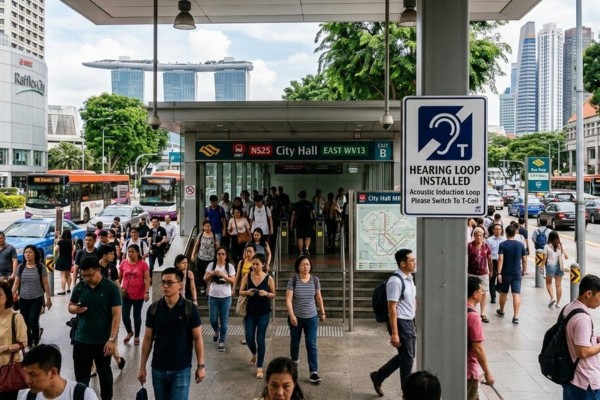
  • Safety announcements in transport hubs, malls, and event spaces may not reach those who rely on hearing aids or cochlear implants.
  • Frontline staff must repeat themselves, shout, or rely on family members as informal “interpreters,” increasing stress, queue times, and the risk of mistakes.
  • Internal meetings and staff training sessions exclude employees with hearing loss, undermining productivity and contradicting HR’s inclusion goals.

These are all avoidable with correctly designed and maintained hearing enhancement systems that deliver clear, direct audio to users’ devices in noisy or reverberant environments.

The cost of inaction vs. the cost of doing it right

From a risk perspective, the “do nothing” path is increasingly hard to justify. Non-compliance with BCA’s accessibility expectations can force expensive retrofits later. Lost customers, reputational damage, and staff inefficiencies quietly erode revenue year after year. In contrast, modern induction loops, digital FM, infra-red and emerging broadcast-audio solutions such as Auracast-based systems offer relatively low running costs, long lifespans, and straightforward user experiences, especially when designed and commissioned by trained specialists.

For Singapore establishments, the question is no longer “Can we afford to invest in hearing accessibility?” but “How long can we afford the legal, operational, and reputation risks of not doing so?”

If you’re ready to move from risk to resilience and build truly inclusive spaces, explore practical solutions here:

Related Projects

Nee Soon South Community Club

Nee Soon South Community Club Nee Soon South Community Club Image by OnePA   Nee Soon South Community Club, located…


Frasers Tower

Frasers Tower Featured Project Madame Tussauds Singapore is a world famous Wax museum and tourist attraction at the Imbiah Lookout…


Lentor Health Nursing Home

Lentor Health Nursing Home Featured Project Photo by Finbar Fallon   West Coast Nursing Home, located in the serene West…


What “Inclusive Infrastructure” Really Means in Modern Building Design


“Inclusive infrastructure” has become a buzzword in architecture and urban planning, but in Singapore it is far more than a trend or a box‑ticking exercise. It is about creating buildings and public spaces that everyone can use with comfort, safety, and dignity—regardless of age, mobility, sensory ability, or background. In a dense, fast‑evolving city, inclusive infrastructure is increasingly a core measure of whether a building is truly future‑ready.

Designing for Real People, Not “Average” Users

At its heart, inclusive design starts from one simple idea: people are diverse, and our buildings should reflect that. Instead of designing for a narrow “average” user, inclusive infrastructure anticipates a wide range of real‑world needs—older adults, children, wheelchair users, people with temporary injuries, neurodivergent users, and those with hearing or vision loss. When design teams plan circulation routes, entrances, signage, acoustics, and technology with this spectrum in mind, buildings become easier and more intuitive for everyone, not just for a minority.

The Singapore Context: Beyond Basic Compliance

In Singapore, this philosophy aligns naturally with the national push toward a barrier‑free and age‑friendly built environment. Accessibility codes and universal design guidelines have raised the baseline: ramps instead of steps as the default, lifts reaching every key level, generous corridors, and accessible toilets that consider caregivers as well as users. But “inclusive infrastructure” goes further than basic compliance. It asks how a space actually feels and functions in daily life. Are wayfinding cues clear enough for someone with low vision? Are queues and counters manageable for someone using a walker or pushing a stroller? Is the sound environment friendly to people who rely on hearing devices?

Why Sensory Accessibility Matters

This is where sensory accessibility becomes just as important as physical access. Many modern interiors are visually impressive but acoustically harsh, filled with reverberation and background noise. For people with hearing loss, this can make announcements, group discussions, and even casual conversations exhausting or impossible to follow. Inclusive infrastructure recognises that access to information is as critical as access to doorways and lifts. A beautifully ramped auditorium is still exclusionary if half the audience cannot clearly hear the performance or speech.

Assistive Listening as Core Infrastructure

To bridge this gap, forward‑thinking projects increasingly integrate assistive listening technologies into their core design, rather than treating them as afterthoughts. Induction loop systems, Digital FM, infra‑red systems, induction loops and newer Bluetooth‑based solutions can offer discreet audio pathways that deliver clear, intelligible sound directly to hearing aids, cochlear implants, headsets, or personal devices. In practice, this can be the difference between a person merely occupying a seat in a room and actually participating in what is happening there—whether it is a lecture, a council meeting, a worship service, or a live performance.

Inclusive Design Benefits Everyone

Importantly, inclusive infrastructure is not only about permanent disabilities. A young professional who forgot their glasses, a tourist struggling with announcements in a noisy station, or a parent holding a sleeping child in a crowded hall all benefit from clearer sound, better sightlines, and more legible spaces. Good inclusive design also serves people with temporary conditions, language barriers, or sensory overload. The result is a built environment that is more forgiving, more humane, and ultimately more resilient as society ages and expectations rise.

A Strategic Advantage for Building Owners

For building owners and operators in Singapore, investing in inclusive infrastructure also brings practical benefits. Spaces that are easier to navigate and understand reduce frustration, complaints, and safety risks. Venues that communicate a strong commitment to inclusion—through visible signage, staff training, and integrated assistive technologies—send a positive signal to tenants, patrons, and regulators alike. In competitive markets such as retail, hospitality, healthcare, and education, this can be a real differentiator, transforming accessibility from a cost centre into a strategic advantage.

Inclusion as a Statement of Respect

Most importantly, inclusive infrastructure is about respect. When people with hearing loss can follow every word of a presentation, when seniors can move confidently from MRT to mall to medical appointment, and when families of all shapes and sizes feel welcome in shared spaces, the city becomes more cohesive. Buildings stop being just containers for activity and start functioning as true public assets—places where participation is possible for everyone, not just for those who fit a narrow physical or sensory profile.

Take the Next Step Toward Inclusive Infrastructure

If you are designing, upgrading, or operating a space in Singapore and want to make it genuinely inclusive—especially for people with hearing loss—specialised hearing enhancement technologies are an essential part of the solution. Explore how you can integrate

to move beyond basic compliance and build truly inclusive infrastructure for today—and tomorrow.


Related Projects

Khalid Mosque

St. Joseph’s Church

Masjid Khalid or Khalid Mosque, is a serene haven of Islamic spirituality and architectural elegance. Established in 1917, it stands…


Slingshot Singapore

Nestled in the lush greenery of Mandai, Bird Paradise is a captivating avian haven. Home to over 300 species, it's…


Woodlands Memorial

Learn how The Listening Lab helped Woodlands Memorial Columbarium elevate their space and ensure that everyone can hear and be…