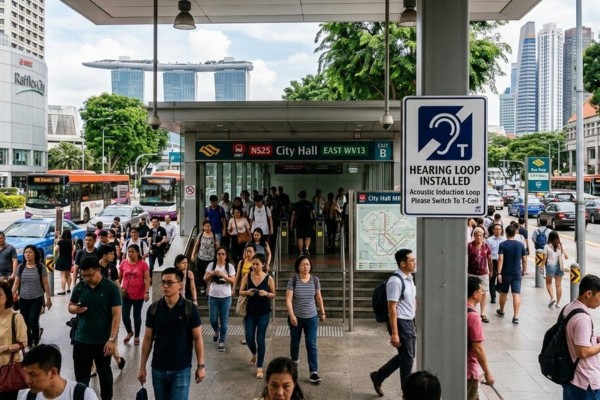
In Singapore, poor hearing accessibility is no longer a “nice to have” problem—it is becoming a compliance, operational and reputation risk for building owners, operators, and brands. The combination of evolving accessibility requirements and clearer expectations around inclusion means that ignoring hearing access can quietly hurt approvals, trigger complaints, and damage trust with customers and staff.
Why hearing accessibility is now a compliance issue
Singapore’s Building and Construction Authority (BCA) Code on Accessibility has, since 2013, required new buildings and those undergoing additions and alterations to provide Hearing Enhancement Systems (HES) in specified spaces, such as rooms used for conferences, lectures, and presentations. These requirements were maintained and strengthened in subsequent revisions (2019 and 2025), reflecting Singapore’s vision of accessibility that explicitly includes people with hearing impairment, not only those with mobility challenges.
For developers, landlords, and facility managers, this means that hearing systems (loops, FM, IR or equivalent) and proper signage are now part of baseline regulatory expectations rather than optional extras. Non-compliance can surface during design review, TOP/CSC, or later retrofits, leading to redesign, delays, and unplanned retrofit costs that are far higher than getting it right the first time.
The hidden legal risk: rights and complaints
Singapore has ratified the UN Convention on the Rights of Persons with Disabilities (CRPD), which recognises access to information and communication as a core right for persons with disabilities, including deaf and hard-of-hearing people. While Singapore does not yet have a single omnibus disability-rights act, legal and policy expectations are moving in the same direction: public-facing services should provide reasonable accommodations and avoid exclusionary practices.
In practice, this creates several hidden legal exposures for establishments that neglect hearing access:
- Formal complaints to regulators, industry bodies, or advocacy groups when customers cannot reasonably participate in services or events due to inaudible announcements or presentations.
- Complaints or concerns around exclusion, lack of reasonable accommodation or poor inclusive-service practice if no assistive listening is offered despite clear technical solutions being widely available.
- Heightened risk in sensitive domains (healthcare, transport, financial services, education) where miscommunication can lead to safety or consent issues, as documented in research on healthcare access for Deaf patients in Singapore.
Each complaint forces management to spend time and resources responding, and repeated issues can draw unwanted attention from regulators and the media even before any formal prosecution is considered.
Reputation damage: “We don’t feel welcome here”
Reputation risk is often more immediate than legal risk. Hearing loss is common and growing—WHO estimates that over 1.5 billion people worldwide live with some degree of hearing loss and that unaddressed hearing loss costs the global economy around US$980 billion annually in health, education, productivity, and social costs. When venues fail to provide clear audio access, affected customers experience this not as a technical flaw but as a message: “people like you were not considered.”
Studies and reviews highlight that people with hearing loss commonly face social isolation, reduced participation, and frustration, particularly when environments fail to provide basic accommodations. In Singapore, qualitative work on Deaf and hard-of-hearing communities describes an “inaccessible environment” created by a hearing-majority society that designs spaces and services without meaningful input from deaf users. For a brand, that translates into:
- Negative word-of-mouth and social media posts about “unfriendly” or “non-inclusive” venues.
- Loss of loyalty from older adults, hearing-aid users, and their families—often some of the most consistent and high-value customer segments.
- Difficulty aligning with ESG, CSR, or “inclusive workplace” claims when lived experiences tell a different story.
A single high-profile incident—such as a customer missing a safety announcement, a critical instruction at a bank counter, or key content in a paid event—can travel far faster than any marketing campaign.
Operational and safety risks you can’t see on a drawing
Beyond formal compliance and brand perception, poor hearing accessibility quietly undermines operations. Research on Deaf healthcare access in Singapore shows that communication barriers and lack of familiarity with Deaf culture directly impair the quality and accessibility of healthcare, with miscommunication around diagnosis, treatment, and consent. Similar patterns play out in other sectors when spoken information is not supported by assistive listening technology:
- Safety announcements in transport hubs, malls, and event spaces may not reach those who rely on hearing aids or cochlear implants.
- Frontline staff must repeat themselves, shout, or rely on family members as informal “interpreters,” increasing stress, queue times, and the risk of mistakes.
- Internal meetings and staff training sessions exclude employees with hearing loss, undermining productivity and contradicting HR’s inclusion goals.
These are all avoidable with correctly designed and maintained hearing enhancement systems that deliver clear, direct audio to users’ devices in noisy or reverberant environments.
The cost of inaction vs. the cost of doing it right
From a risk perspective, the “do nothing” path is increasingly hard to justify. Non-compliance with BCA’s accessibility expectations can force expensive retrofits later. Lost customers, reputational damage, and staff inefficiencies quietly erode revenue year after year. In contrast, modern induction loops, digital FM, infra-red and emerging broadcast-audio solutions such as Auracast-based systems offer relatively low running costs, long lifespans, and straightforward user experiences, especially when designed and commissioned by trained specialists.
For Singapore establishments, the question is no longer “Can we afford to invest in hearing accessibility?” but “How long can we afford the legal, operational, and reputation risks of not doing so?”
If you’re ready to move from risk to resilience and build truly inclusive spaces, explore practical solutions here: