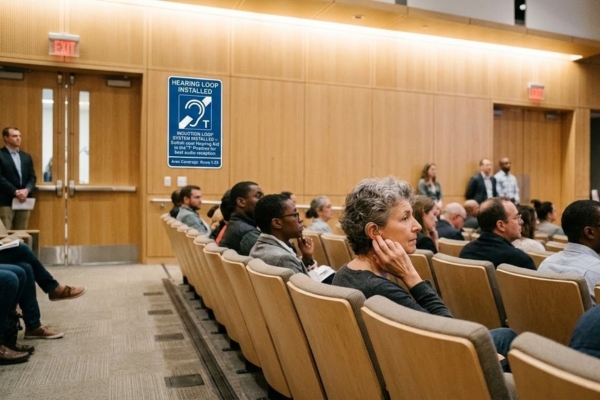
BCA compliance in Singapore is often pictured as ramps, handrails, and wider doorways. Yet for hundreds of thousands of people with hearing loss, a building is not truly accessible if they cannot clearly hear and understand what is being said inside it.
The Building and Construction Authority’s (BCA) accessibility framework is ultimately about participation and safety, not just physical movement. When we focus only on mobility features and forget hearing accessibility, we unintentionally exclude a large group of users from announcements, services, and experiences that happen through sound.
BCA compliance is more than barrier-free routes
Traditional accessibility upgrades are highly visible: step-free entrances, lifts, tactile paving, accessible toilets, and wheelchair spaces. These are essential and widely recognised by architects, builders, and owners as part of compliance.
But many key functions of a building are delivered through audio, for example:
- Safety announcements in transport hubs and malls
- Service interactions at counters and reception desks
- Lessons in classrooms and lecture theatres
- Sermons and presentations in houses of worship and auditoriums
When these environments are not equipped with hearing assistance technology, people with hearing aids or cochlear implants may still struggle, even if the building is “BCA-compliant” on paper. They can enter and move around, but they cannot fully follow what is being said.
Why hearing accessibility is often overlooked
Hearing inclusion tends to be neglected for a few practical reasons:
- It is invisible. A ramp or lift is obvious; a well-designed hearing system blends into the environment, so decision makers may not even know it exists.
- Hearing loss is underestimated. Many treat it as an “elderly issue”, but students, working adults, and children also live with hearing difficulties.
- Design teams focus on structure, not sound. Accessibility discussions are often led by architects and engineers whose main outputs are physical features and layouts.
- Lack of enforcement awareness. Owners may not realise that providing a means for effective communication is part of inclusive design, not an optional extra.
The result is a gap: buildings pass basic compliance checks while still excluding people who cannot hear clearly in noisy, reverberant, or crowded spaces.
The case for audio inclusion
True accessibility means a person with hearing loss can:
- Hear emergency and safety messages in real time
- Communicate with staff at counters without embarrassment or repeated misunderstandings
- Follow meetings, lessons, or services without fatigue
- Participate independently, without needing to ask for special arrangements each time
Hearing enhancement systems bridge the distance between the sound source (like a microphone) and the listener’s hearing device or receiver. Instead of relying on loudspeakers that compete with background noise and poor acoustics, sound is transmitted directly to the user in a clean, intelligible way.
For building owners and facility managers, this does three important things:
- Reduces risk in emergencies, because critical announcements reach more people
- Improves user satisfaction and perceived professionalism in service environments
- Future-proofs the building as Singapore’s population ages and expectations for inclusion rise
In other words, investing in hearing accessibility is not just about ticking a compliance box; it is about delivering a better-quality experience for everyone.
Practical ways to integrate hearing systems
The good news is that hearing accessibility can be designed into both new and existing buildings with solutions that suit different spaces and use cases:
- Induction loop systems
These create a magnetic field that transmits audio directly to hearing aids and cochlear implants equipped with a telecoil (T-coil). They are ideal for counters, meeting rooms, auditoriums, classrooms, houses of worship, and theatres where many users may have hearing devices.
- Digital FM systems
Digital FM solutions use radio frequencies to send the speaker’s voice to personal receivers. They are useful in flexible spaces such as classrooms, tour settings, training rooms, or venues where users may not have T-coil enabled devices.
- Infra-red systems
Infra-red solutions transmit audio via light signals to dedicated receivers, making them suitable for courtrooms, cinemas, confidential meetings, and corporate spaces where privacy and containment of audio are important.
- Auracast-ready solutions
Newer technologies like Auracast use Bluetooth broadcast audio to let users receive sound directly on compatible smartphones, earbuds, and hearing devices. This supports a more seamless and familiar user experience, especially for younger, tech-comfortable listeners.
By planning these systems alongside ramps, lifts, and tactile indicators, building owners move closer to what BCA’s accessibility agenda is really about: enabling people to move, hear, understand, and participate safely and independently.
If you are looking to strengthen your BCA compliance and close the hearing gap in your building, explore our dedicated solutions: induction loop systems, Digital FM, Infra-red, and Auri by Auracast.