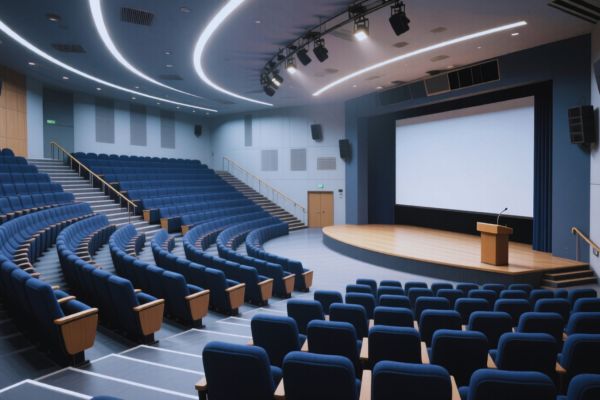
For many venues in Singapore, assistive listening is treated as a checkbox for compliance rather than as a core part of guest experience. That mindset leads to systems that technically exist on paper but are barely used, poorly maintained, and invisible to the people who need them most.
Mistake 1: Treating HES as just “AV equipment”
A hearing enhancement system is not just another microphone or loudspeaker; it is an accessibility tool governed by BCA’s Code on Accessibility and disability‑inclusion best practices. When venues leave the decision entirely to a general AV vendor without specialist input, they often end up with systems that do not meet coverage, intelligibility, or privacy needs.
The result is a loop, FM, IR, or Auracast setup that looks good in a schematic but fails real users in a noisy hall, echoey sanctuary, or glass‑heavy meeting room. In Singapore, engaging a provider that focuses specifically on assistive listening—rather than “audio in general”—is critical to getting the design right.
Mistake 2: Ignoring venue layout and construction
Building owners often assume “one size fits all”, selecting a technology based on price or catalog descriptions instead of room shape, construction materials, and usage patterns. For example, a simple perimeter hearing loop may not perform well in odd‑shaped rooms, spaces with heavy steel reinforcement, or stacked floors where crosstalk can occur.
Likewise, infrared systems demand clear line‑of‑sight and suitable lighting conditions, while Digital FM thrives in flexible, temporary setups such as training rooms or tours. A short design consultation can surface these constraints early and avoid expensive rework or disappointing performance on opening day.
Mistake 3: Choosing purely on cost, not lifecycle
It is common to choose the lowest‑cost proposal without factoring in staffing, consumables, and the total cost of ownership over ten years. Digital FM and IR systems, for example, require receivers and neckloops to be issued, collected, cleaned, and charged after every event, which quietly adds labour and operational overhead.
By contrast, a well‑designed induction loop lets most hearing aid and cochlear implant users connect directly via their telecoil with no extra hardware to manage, reducing friction for guests and staff. Newer Auracast‑based systems like Auri can also reduce hardware dependency over time by letting compatible phones and hearing devices connect straight to the broadcast.
Mistake 4: Overlooking user experience and signage
Another frequent mistake is installing a compliant system and then hiding it—no signage, no staff awareness, no clear instructions. Without the familiar “blue ear” sign and simple guidance (“Switch your hearing aid to T‑coil” or “Scan this Auracast channel”), many guests never realise help is available.
Venues also forget to test the experience from the listener’s perspective: is the speech clear, is background music overwhelming, does the coverage match the advertised seats? Regular checks and basic staff training turn a silent, underused asset into a visible, valued service that guests learn to trust.
Mistake 5: Failing to future‑proof the investment
Singapore’s accessibility landscape is evolving quickly, with stronger expectations around inclusive audio in public, educational, and commercial spaces. Some venues still lock themselves into legacy‑only systems without considering how they will serve both today’s hearing aid users and tomorrow’s Auracast‑enabled phones and hearables.
A more resilient strategy is to design for coexistence: loops for guaranteed compatibility with telecoil users, Digital FM or IR where portability or confidentiality is key, and Auracast (Auri) layered in for scalable, smartphone‑friendly listening. This blended approach makes upgrades incremental rather than disruptive and shows regulators, tenants, and guests that the venue is committed to long‑term inclusion.
Mistake 6: Skipping specialist commissioning and support
Finally, many projects stop after installation, with no proper commissioning, measurement, or documentation according to international standards for assistive listening. Without calibrated levels, coverage verification, and as‑built records, it becomes hard to troubleshoot complaints or prove compliance later.
Partnering with a specialist who can design, install, test, and maintain the system—rather than a one‑off installer—helps ensure the HES continues performing as the venue changes over time. That includes support for expansions, refurbishments, and integration with new AV or broadcast platforms like Auracast.
If you want to avoid these common mistakes and design an assistive listening system that truly works for your guests in Singapore, explore our solutions: induction loop systems, Digital FM, Infra-red, and Auri by Auracast.